
San Diego County Recent Arrest Sources
The county's central tool is Who's In Jail, run by the San Diego County Sheriff's Office for adults currently in Sheriff custody. It is a name search. It is not a stream of every arrest. A match means the Sheriff's system holds a matching custody record. No match could mean the person is still in local police hands. They may have been cited or released. A transfer is possible too. So is a name variation. The person may never have entered county custody at all. The arresting agency keeps one piece. The District Attorney and the Superior Court each keep a separate piece of the record chain.
No official list covers everyone booked in the last day. No public person-level weekly booking export exists either. The two time-window guides therefore explain verification instead of offering invented feeds. The 24 Hour Arrests guide covers the same-day window. The Arrest Log guide handles multi-day searches, selective police releases, and older-record requests. The Sheriff links its roster to VINE notifications. That covers custody changes tied to one identified person.
| Need | Best starting point | What it covers |
|---|---|---|
| Current custody | Who’s In Jail | Named adults in active Sheriff custody |
| Same-day check | Roster plus arresting agency | Current booking detail and selected agency information, with processing lag |
| Several days or older | Official releases and records request | Selected incidents or a requested report, not a complete public blotter |
| Case filing and result | District Attorney and Superior Court | Case entries, dates, filings, and official court documents |
Search the San Diego Arrest Roster
Start with a surname and given name in the Sheriff's roster. The search form may demand a minimum number of letters plus a five-character verification code. Open the individual detail page instead of trusting a bare name list. The booking number is the strongest public cross-reference. The Arrest Agency and Date and Time Booked fields separate police action from county intake. Those two times are not the same thing. The Sheriff notes that local processing before booking can take up to four hours.
The roster names a detention site when one is assigned. Housing location is not the place of arrest. Placement can shift at any time. Under the Sheriff's stated routing, San Diego Central Jail and Vista handle male intake. Las Colinas and Vista handle female intake. Other adults land at South Bay, George Bailey, East Mesa, or Rock Mountain. Juvenile detention sits with County Probation and never appears in the adult roster.
| Search or detail field | How to read it |
|---|---|
| Last and first name | Name-based search terms; try a supported spelling variant if needed |
| Booking Number | County booking reference for follow-up questions and requests |
| Arrest Agency | Agency credited in the custody record, not the court |
| Date and Time Booked | County intake time, which may follow the arrest |
| Facility or Housing Location | Current operational placement, subject to transfer |
| Bail and Sentenced fields | Status fields that require confirmation as the record updates |
| Charge and case data | Charges and classifications, not a judgment of guilt |
The sheriff's Who's In Jail screen is the official starting point. It covers people currently in custody in San Diego County. Searches run by name. Arrest lookups begin there.
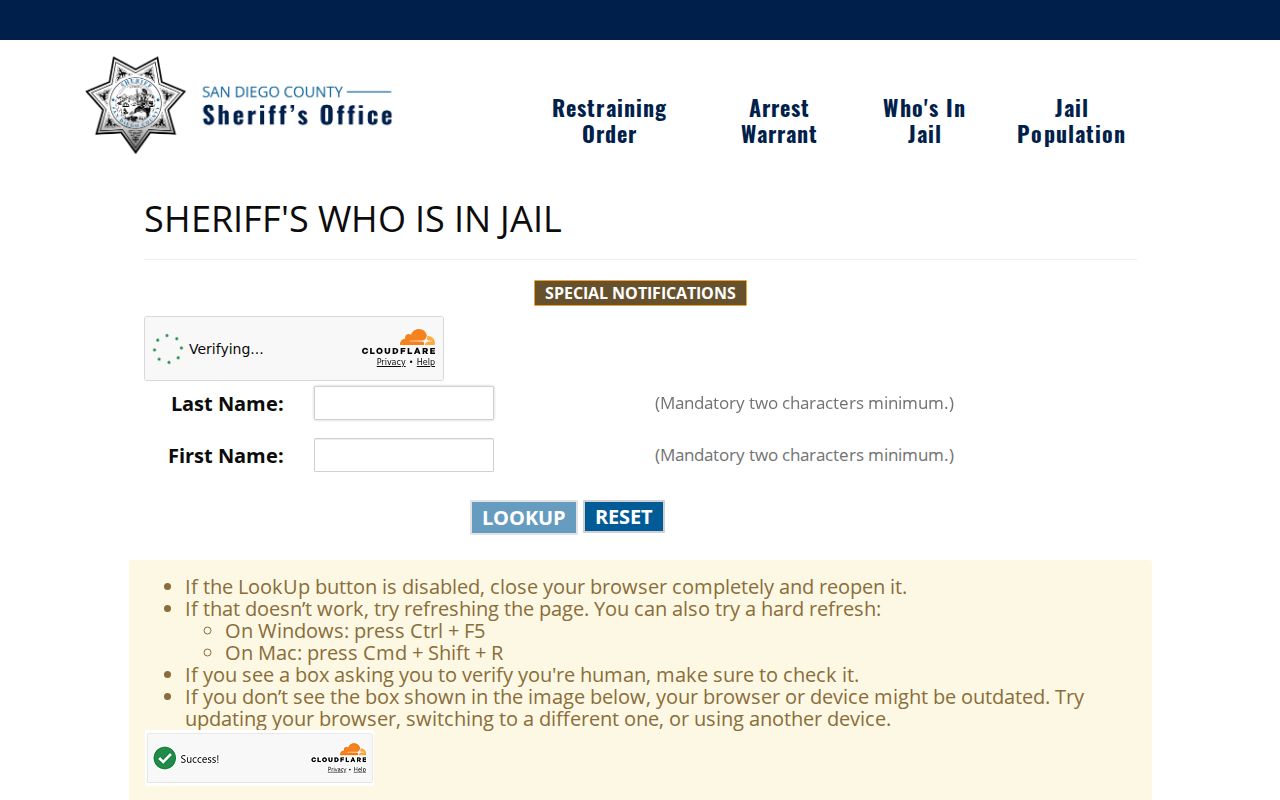
This page works as a search tool. It is not a photo gallery. Booking details appear only after a query. San Diego arrest results stay limited to one person at a time.
When San Diego Roster Data Lags
A fresh arrest does not hit the roster instantly. The Sheriff's custody guide allows up to four hours for pre-booking work by the arresting agency. A roster update can trail even further behind. Someone released before you search may never appear at all. Check the name spelling first. Wait out the documented processing window. If the matter is urgent, call the public custody-information line at 619-409-5000. Access has its own quirks. The roster goes down for maintenance each Wednesday around noon for roughly thirty minutes. Projected release dates can shift while calculations change, so treat them as a status field rather than a promise. When a release or transfer truly matters, confirm it with the facility and follow the VINELink Check instructions. VINE sends notices after registration. It is not an emergency service, though, and it keeps no permanent arrest archive.
Seven San Diego County Custody Facilities
The Detention Services Bureau books, classifies, houses, and releases roughly 100,000 people a year. It spreads that work across seven principal adult sites. The list includes San Diego Central Jail and Vista Detention Facility. Las Colinas Detention and Reentry Facility is on it too. So are South Bay Detention Facility, George Bailey Detention Facility, East Mesa Reentry Facility, and Rock Mountain Detention Facility. All seven belong to one county system. The roster's facility field shows where a person is held. It does not reveal which street or city supplied the arrest.
Routing adds another layer. Vista serves as the main intake point for North County. An Oceanside arrest accepted there may well land at Vista. Chula Vista's city jail is temporary. It hands people to the Sheriff or another suitable facility after local processing. San Diego Police arrests can likewise enter county custody once city procedures wrap up. Citation, local release, book-and-release, and transfer paths all exist. Any of them may keep an event from looking like a stable roster entry. That is why two facts matter. The arresting agency and the booking facility must be reported separately.
Where San Diego Arrests Are Published
Start any San Diego arrest search with official sources. The Sheriff's roster answers who is in custody right now. Newsrooms at the Sheriff's Department and the city agencies publish only selected events. Dispatch and calls-for-service pages describe police operations, not bookings. Local journalism can add context to a reported case. KPBS is one example. No outlet replaces the agency record or the court file. Commercial aggregators run stale, incomplete, or simply wrong. The statewide services offer no dependable current San Diego section.
| Channel | Photos? | Status | Proper use |
|---|---|---|---|
| Sheriff Who’s In Jail | No routine booking-photo display | Official | Check current adult county custody |
| Sheriff and police releases | Sometimes, with a release | Official but selective | Read the agency account of a named event |
| DA and Superior Court | No mugshot gallery | Official | Check filing, dates, and court documents |
| CDCR CIRIS | Record-dependent | Official state source | Search state prison custody |
| Local news | Article-dependent | Independent and selective | Use as dated context, then verify |
| Commercial arrest pages | Varies | Unofficial | Treat only as a lead; never assume it is current |
The San Diego Police Department News Center posts selected press releases. It covers incidents the agency chooses to publicize. That differs from a countywide booking log. An arrest can happen with no release at all.
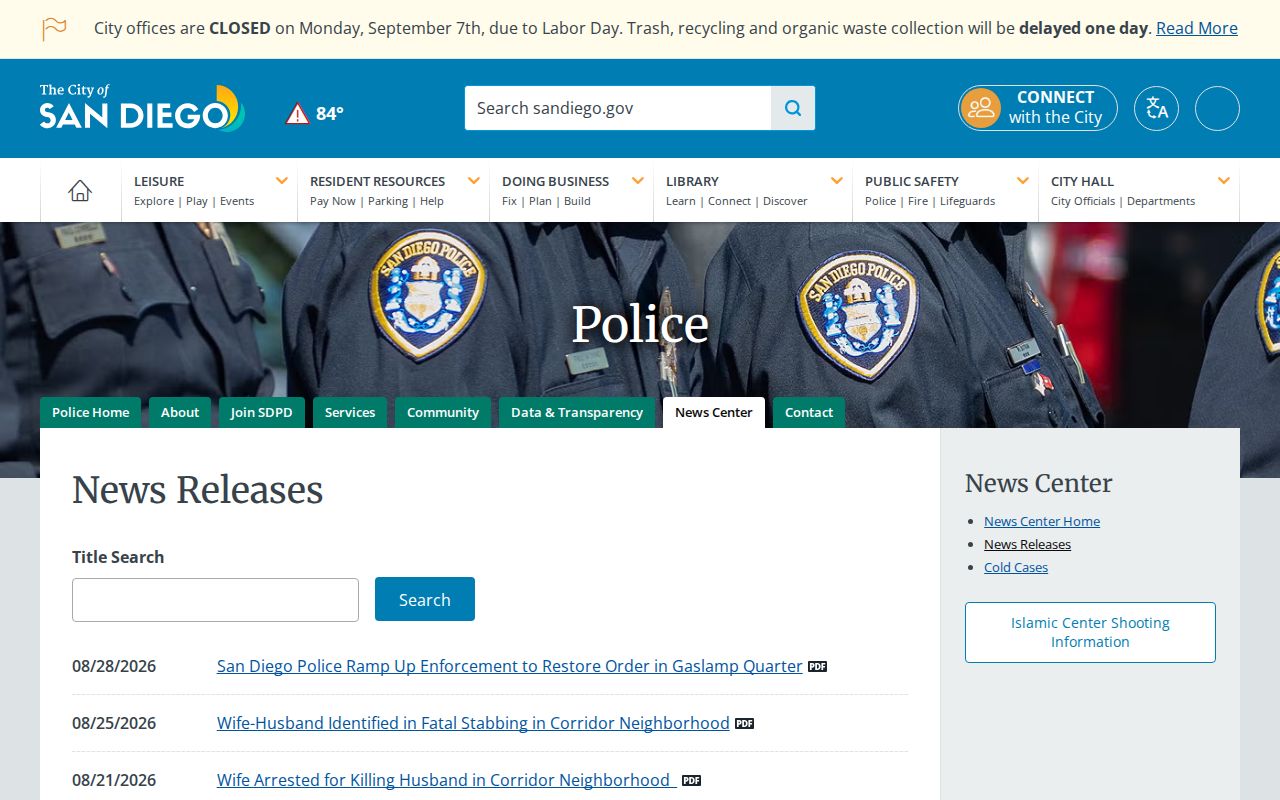
One release may cover a single incident. Many San Diego arrests never get a release. A roster, records request, or court check fills those gaps. Start with the jail roster.
San Diego County Arrests by City
City police pages come first in a search, before county booking takes over. The San Diego Recent Arrests page walks through SDPD's News Center picks. It also covers the Dispatch Online feed. Chula Vista Police keeps a Press Log you can filter by date, plus a temporary city jail. From there, some arrestees move into Sheriff custody. Oceanside Police posts event-driven press releases instead of a daily log. Vista matters most as the North County custody cross-check. Together these pages keep a local police event separate from the later San Diego County booking.
- San Diego Recent Arrests: SDPD releases, dispatch context, report requests, and the county roster handoff.
- Chula Vista Recent Arrests: CVPD Press Log, temporary holding, records access, and transfer to county custody.
- Oceanside Recent Arrests: OPD releases, public records, and Vista intake checks.
Read a San Diego Booking Record
A booking record documents county intake. Nothing more. It is not the police narrative, not the DA's filing call, and not the court's final word. The Sheriff may list identity descriptors, the arresting agency, booking time, housing placement, bail status, and charge data. Every field should keep its source label. Descriptive data can be stale or plain wrong, housing shifts, and charge codes should stay unexpanded unless an official source supplies the meaning.
| Field group | What it shows |
|---|---|
| Identity | Name plus record-dependent age and physical descriptors used to distinguish matches |
| Booking | Booking number, arrest agency, and county intake date and time |
| Custody | Current facility or housing placement and status fields |
| Bail | Listed bail information or status, subject to change and verification |
| Charge | Case or record-of-charge data and felony, misdemeanor, or infraction class |
| Release | Projected or sentenced information when present, not a guaranteed release event |
A booking happens when a person is arrested in San Diego County. The person is then formally entered into jail custody. Arraignment comes later in court, where the charges are read. Bond is money or conditions set for release before trial. Expungement is a court-ordered form of relief. It can clear parts of an arrest record. The order may not reach every copy or every file that exists.
Request San Diego County Arrest Records
The live roster only goes so far. For deeper documents, San Diego County routes requests elsewhere. The Sheriff’s crime, arrest, and accident report process handles those. Records & ID sits at 9621 Ridgehaven Court, San Diego, CA 92123, phone 858-974-2110. The counter opens weekdays around 8:00 a.m. and closes near 4:30 p.m. A noon-to-1:00 p.m. break splits the day. There is no weekend or holiday service. You can also file through the Public Records Center, any station or substation, or the service form.
Be specific when you ask. Name the person arrested. Include a booking number if you happen to have one. Also give the arresting agency, a date range, and the exact document type. A booking record and an arrest report are separate items. Say which one you want. Want a photo too? Request it on its own, since a released image is not automatic. Redactions and denials can still apply to any San Diego County arrest record.
- Identify the correct agency and record type.
- Collect the booking number, incident number, date range, and name available from official sources.
- Submit through the Public Records Center, service form, mail, or listed counter route.
- Expect the source’s fee rules. Sheriff report copies are generally listed at $20, while local criminal-history requests are listed at $14.
- Use the stated 3-to-10-business-day goal as an estimate, not a guarantee.
Retention varies by agency in San Diego County. Most crime, arrest, and accident reports are kept for ten years. Some serious or open cases stay on file longer. No fixed deletion schedule covers every booking photo or roster entry. Assume nothing about when a record disappears.
Fees differ too. SDPD lists fifty cents for a first page. CVPD charges one dollar, while OPD posts a $5.50 processing fee. Always check the agency page before you send a request.
San Diego Arrest Photos and Mugshots
The Sheriff’s public roster does not normally display booking photos. That is a core fact about San Diego County arrests. Under Sheriff policy, a photo can go out only for an immediate public-safety need. On top of that, California Penal Code section 13665 limits how law enforcement posts booking photos on social media, with special weight on nonviolent matters and statutory exceptions. A screenshot or a private publisher’s page is no substitute for an official current mugshot source.
Other systems sit at different stages of custody. California Department of Corrections and Rehabilitation records come after a state conviction. CIRIS can find someone in state prison, but it is not a county booking roster. Federal Bureau of Prisons and ICE locators track entirely separate federal or immigration systems. Neither fills a gap in local arrest data. Historical photos are a different world again: the California State Archives keeps old Folsom and San Quentin collections, not a live San Diego County mugshot archive.
For the exact language behind state publication limits, the official California Penal Code section 13665 page carries the primary text.
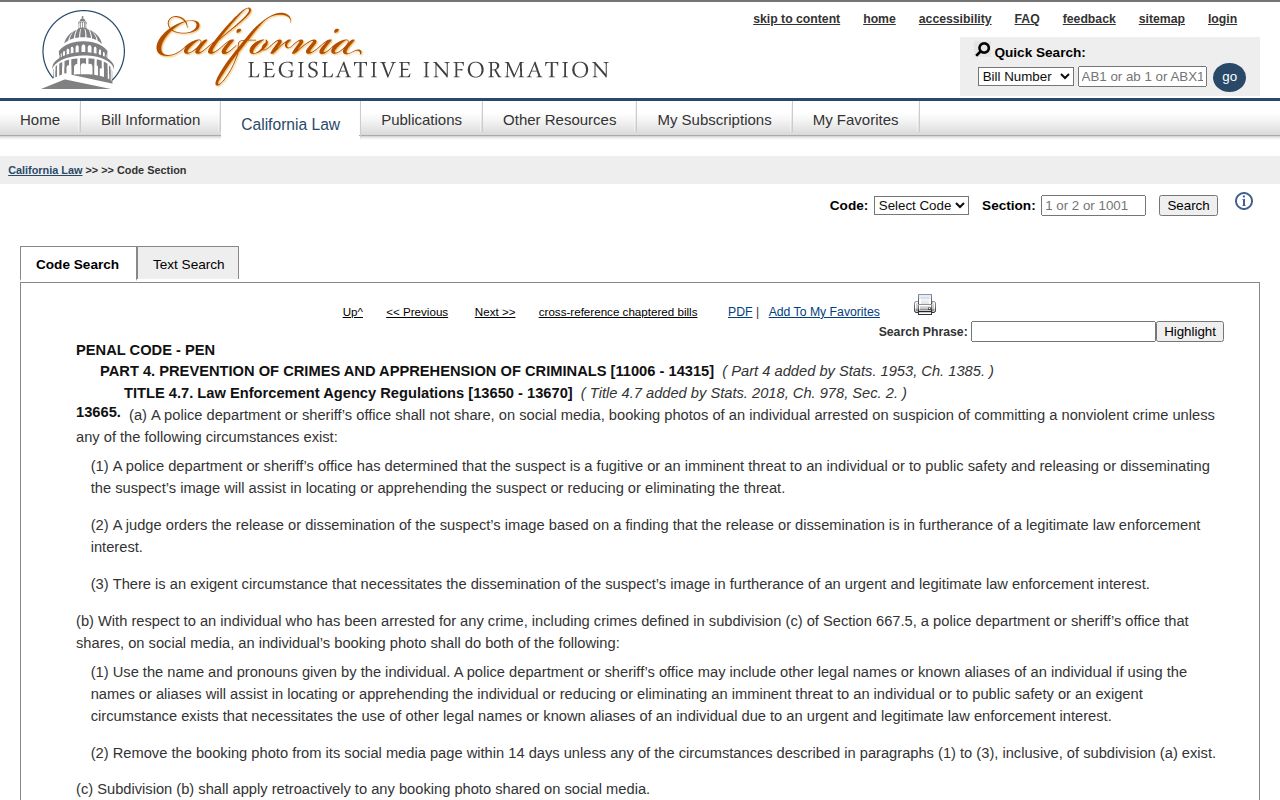
The statute should be read with the Sheriff’s own policy and the facts of the specific request.
California Booking Law and Relief
California public records come with limits. Exemptions and redaction rules trim what agencies release. The Sheriff's report page cites the former Government Code section 6254 framework, while current access decisions depend on applicable California law and the record's contents. The county also points to Government Code section 7923.600 for law-enforcement records. Juvenile matters, sealed files, protected victims, investigative details, and confidential information stay out of bounds.
Record relief runs through the courts. It promises no universal deletion. The San Diego Superior Court explains Penal Code sections 1203.4 and 1203.4a and posts the misdemeanor and felony materials. The Public Defender warns that expungement does not automatically seal a record. Penal Code section 851.92 offers more. The California Attorney General describes that relief. For a correction, turn to the court, the Public Defender, the Attorney General, or qualified counsel, and never pay a commercial site that claims it can erase every official source.
Civil Code section 1798.91.1 targets a different abuse. It reaches businesses that publish arrest booking photographs and seek payment tied to removal. Use any free opt-out with care. Document each step. No paid-removal provider is endorsed here, and none can guarantee that search engines, news reports, court indexes, or lawful official records will vanish.
The San Diego County Public Defender expungement page is an official local starting point for record-relief information.
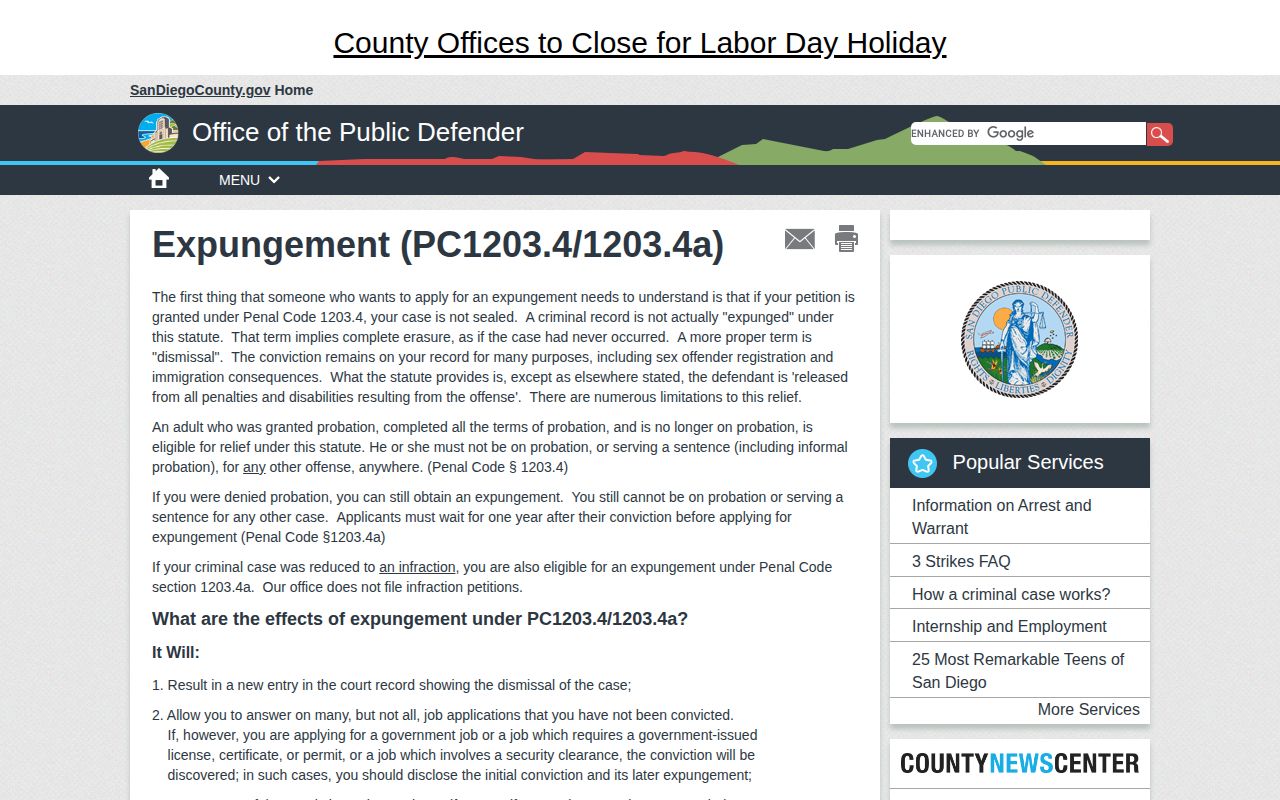
Expungement is a legal process. It is not an automatic seal. Independent publishers are not bound by it.
San Diego County Warrant Search
The Sheriff runs an official warrant search portal that refreshes on an hourly schedule. Results can include cryptic codes. A warrant that looks cleared may still need a call to the issuing court. The Superior Court warrant page is the right second check for court instructions. Keep in mind what a warrant is. It is a court order, not a jail booking.
The Sheriff posts no standalone most-wanted gallery. San Diego County Crime Stoppers publishes selected cases and takes tips, but its notices fall short of a full inventory of active warrants. Never approach someone shown in a wanted notice. Only peace officers may make an arrest. For an urgent safety concern, call law enforcement. For a question about your own status, use the issuing court, counsel, or the official warrant channel. A cached screenshot is not a reliable answer.
The San Diego Sheriff warrant portal carries the source's safety warning along with its search interface.
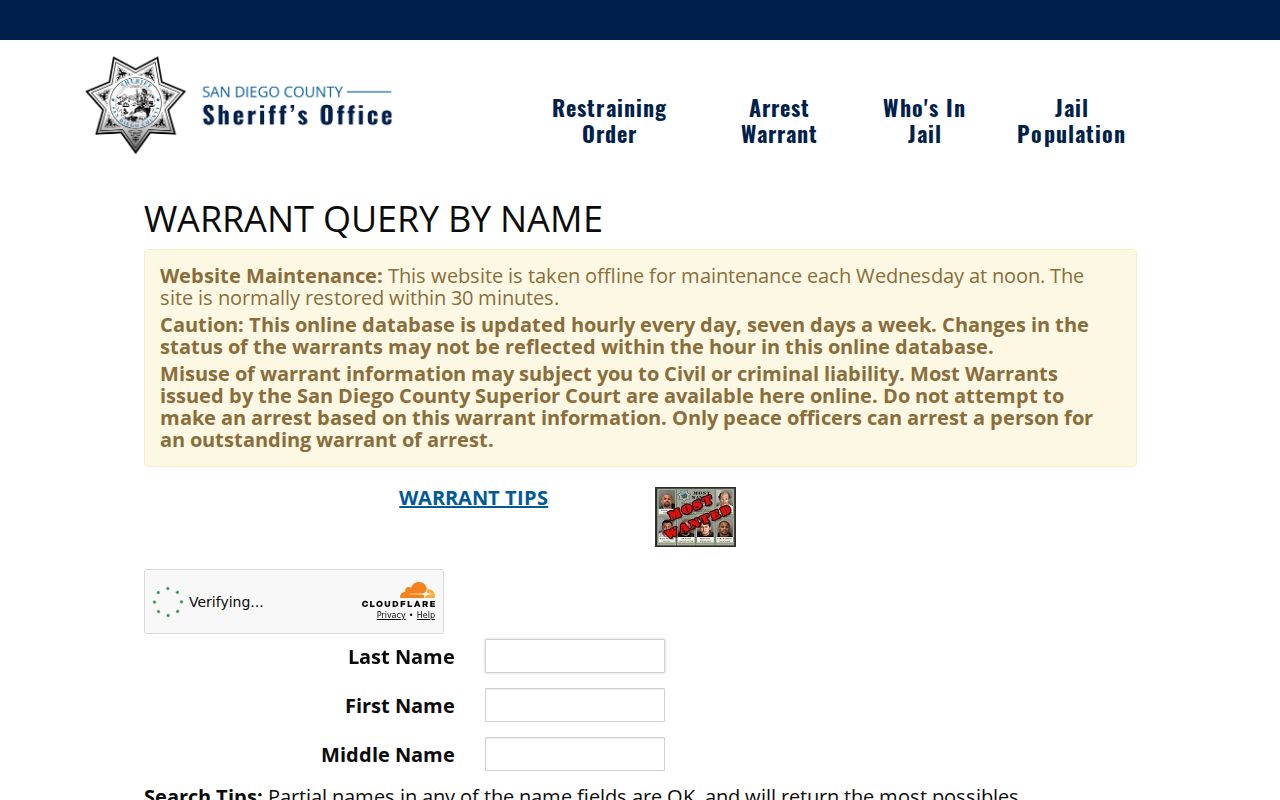
The portal page is for navigation and safety context. It is not a warrant result. It lists no names.
After a San Diego County Arrest
An arrest in San Diego County starts a chain with separate dates. Police make the arrest or issue a citation first. The Sheriff may create a booking afterward. Then the District Attorney can file charges, decline them, or change them. The Superior Court records hearings and the eventual outcome. The DA's public search has limits. Some City of San Diego and Poway misdemeanors, juvenile matters, unsubmitted cases, unfiled charges, and certain closed matters are excluded or restricted. For a newly arrested person, the office advises checking again after a day.
The Superior Court index shows a title, case number, filing date, location, case type, and parties. That is not always the full charge list. It is not a final outcome either. The court warns that an index entry can linger after a dismissal or acquittal. Criminal documents may require a courthouse visit or ordered copies. So an old booking, a missing DA result, and a court index should never get merged into one claim.
Custody after sentencing splits by system. State prison goes through CDCR CIRIS. Federal custody uses the Bureau of Prisons locator. ICE runs its own detainee locator. VINE can send release or transfer alerts, including some moves to another county or state prison, yet it replaces no official custody system.
Does a roster disappearance mean the case ended? No. It may signal release or a transfer. Check the DA and court sources for filing and outcome. When the index is not enough, request the official document.