
How San Diego Arrests Move
The San Diego Police Department patrols the city, while the San Diego County Sheriff's Office runs the county's adult detention system. One police contact can end several ways. An SDPD stop might close with a citation. It might involve brief local processing and release. Or it can end with an adult booking the Sheriff accepts into county custody. Only that path creates a current entry in Who's In Jail. Someone arrested in one part of the city may still be booked miles away, because the arrest location and the jail location often differ. A person who never enters county custody may never appear on the county roster at all.
San Diego is the county seat and its largest city, with 1,389,526 residents in the county's selected 2024 profile. Size guarantees no single arrest list. SDPD keeps the city incident reports. The Sheriff holds booking and custody data. The District Attorney and Superior Court hold later filings and case records. Every system tracks its own dates and identifiers.
SDPD Dispatch Is Not Arrest Data
SDPD Dispatch Online logs police calls, not arrests. Each entry lists the date, time, call type, division, and neighborhood block. That detail helps you locate a reported incident. It cannot tell you who was booked into jail. A dispatch record names no defendant and shows no booking photo or charge. The classification often reflects how a call first came in, not how it ended.
The gap shows up when a San Diego arrest search comes back empty. Calls can close without an arrest. Some end in a citation instead of a jail transfer. An arrest can also happen with no dispatch entry at all, so keep any event number for a records request. The city's dispatch service is a starting point, never a substitute for the booking roster.
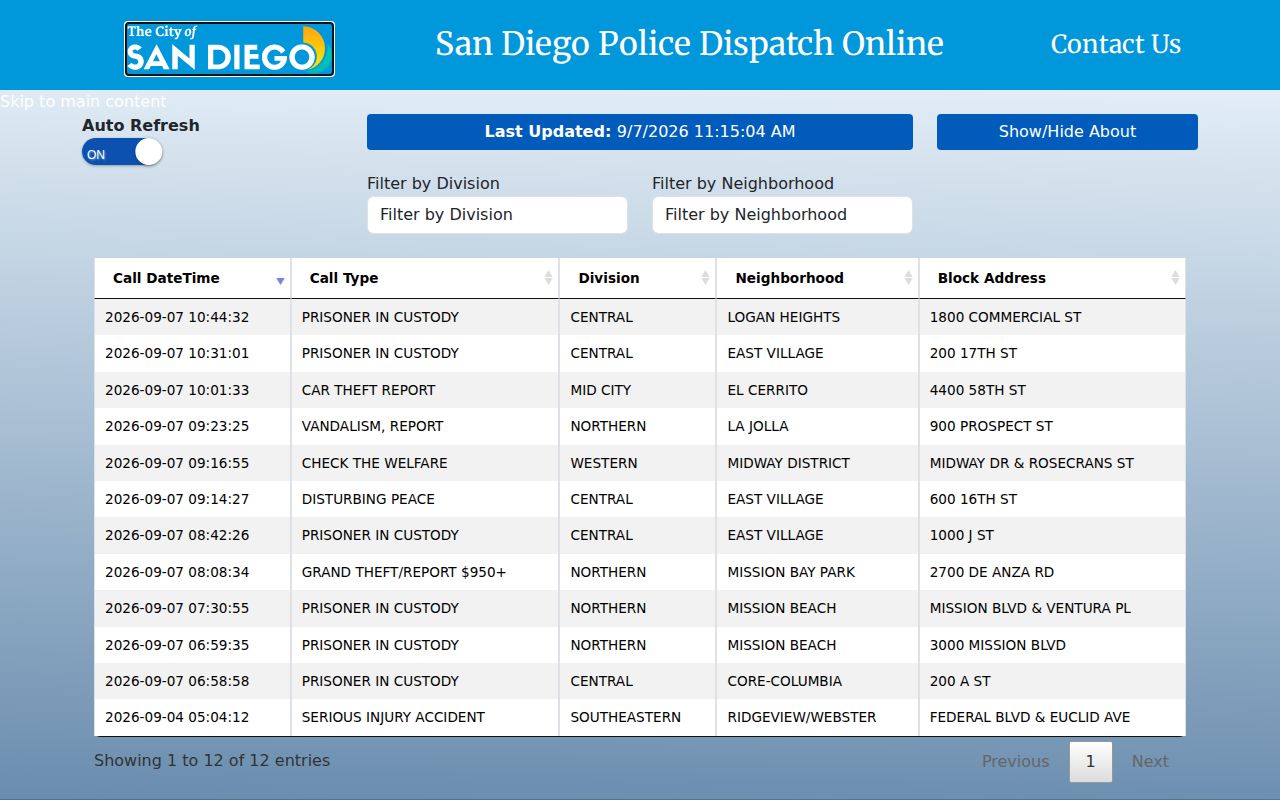
The capture supports incident research, not a list of arrested people.
Where San Diego Arrests Appear
SDPD posts no complete public arrest log and no routine booking-photo gallery. City and county sources answer different questions. Start with official channels, since journalism and old third-party archives sit a step behind. Those secondary leads can be stale, incomplete, or simply wrong.
| Channel | What it shows | Photo status |
|---|---|---|
| SDPD News Center | Selected investigations, arrests, and notices | Some release images; no full gallery |
| Who’s In Jail | Current adult county custody details | No routine booking photo |
| Dispatch Online | Calls, time, type, division, and block | No mugshot roster |
| DA case search | Many filed cases, subject to exclusions | Not a photo source |
| Times of San Diego | Selected event-driven reporting | News or agency images may appear |
| Mugshots.com county archive | Unofficial historical entries | Not official or reliably current |
The DA tool limits some San Diego misdemeanors. It also excludes juvenile matters, unsubmitted cases, unfiled charges, and certain closed matters. A missing entry proves little. Court records, not an early booking or news item, carry the later disposition.
Find a San Diego Booking
Start with the agency and the likely custody stage. Local police processing often comes before any county booking. Someone headed into adult county custody lands on the Sheriff roster, not on Dispatch Online. Pick the source that matches where the person is in the process.
- Search Who’s In Jail by last and first name, including a known spelling variant.
- Open the detail and compare booking number, arrest agency, booking date and time, facility, bail status, and charge class.
- For a fresh event, account for processing delay and call 619-409-5000 when custody confirmation is urgent.
- Check SDPD releases or dispatch for context, without treating either as a complete feed.
- Request the SDPD report for the incident or use court systems for filed-case follow-up.
The roster has no all-bookings date filter. Released people drop from view. Citations, local holds, and book-and-release events may not stay visible either. The San Diego County recent-arrests hub explains roster fields and custody channels, including why Date Booked and Time Booked can differ from the arrest time.
Request San Diego Arrest Records
SDPD sends police-report requests to its Records unit. Include the parties, the date, the location, and any report or incident number you have. The department charges 50 cents for the first page. It also warns that access can be limited. A person named as a suspect may need counsel, discovery, a subpoena, or another authorized route instead.
Use Get a Police Report for the report route and the SDPD Public Records Act page for broader requests. A police report is not a booking record. Ask SDPD for the incident record, and ask the Sheriff for custody material once a transfer happens.
San Diego Police Records
Mail requests go to Records MS#726, PO Box 121431, San Diego, CA 92112. Walk-in service happens at 1401 Broadway, San Diego, CA. Add the parties, the date, and the location. A report or incident number speeds things up.
San Diego Arrest Photos
The Sheriff roster does not routinely show booking photographs. SDPD posts no complete mugshot gallery. When a police release includes a photo, that image belongs to the release alone. It is not an arrest archive. California law and Sheriff policy limit routine publication of some booking photos, especially for nonviolent offenses. A missing public image does not mean no internal photo exists, and it does not change custody status.
Mugshots.com archives San Diego County by city. Entries can linger after a case changes and can conflict with current official sources. Other national sites offer no working San Diego section. Confirm identity and custody status with the originating office and the court, and treat no paid removal offer as a legal remedy.
After a San Diego Arrest
A San Diego arrest sets off a chain of separate records. SDPD documents the city arrest itself. If county custody takes the person in, the Sheriff's office opens a booking record. That record carries its own booking number. Filing belongs to the District Attorney. Any hearings or final disposition land in Superior Court files. The booking number never doubles as a court case number. The DA's search has city-specific gaps, so a missing name proves little. A new San Diego arrest may lag. If it does not appear, try again after 24 hours. A name dropping off the roster is not proof that charges went away.
San Diego Police News Context
The SDPD News Center covers investigations, critical incidents, public-safety notices, and some arrests. Not every arrest gets a release. That is an agency judgment call, so silence is not evidence that nothing happened. When a release names a charge, note its date. Note the language the department used. Then confirm custody or case status through the source that governs that question. Outlets like Times of San Diego, NBC 7, and KPBS add reporting. They run no arrest ledger. The official SDPD News Center source holds the release archive.
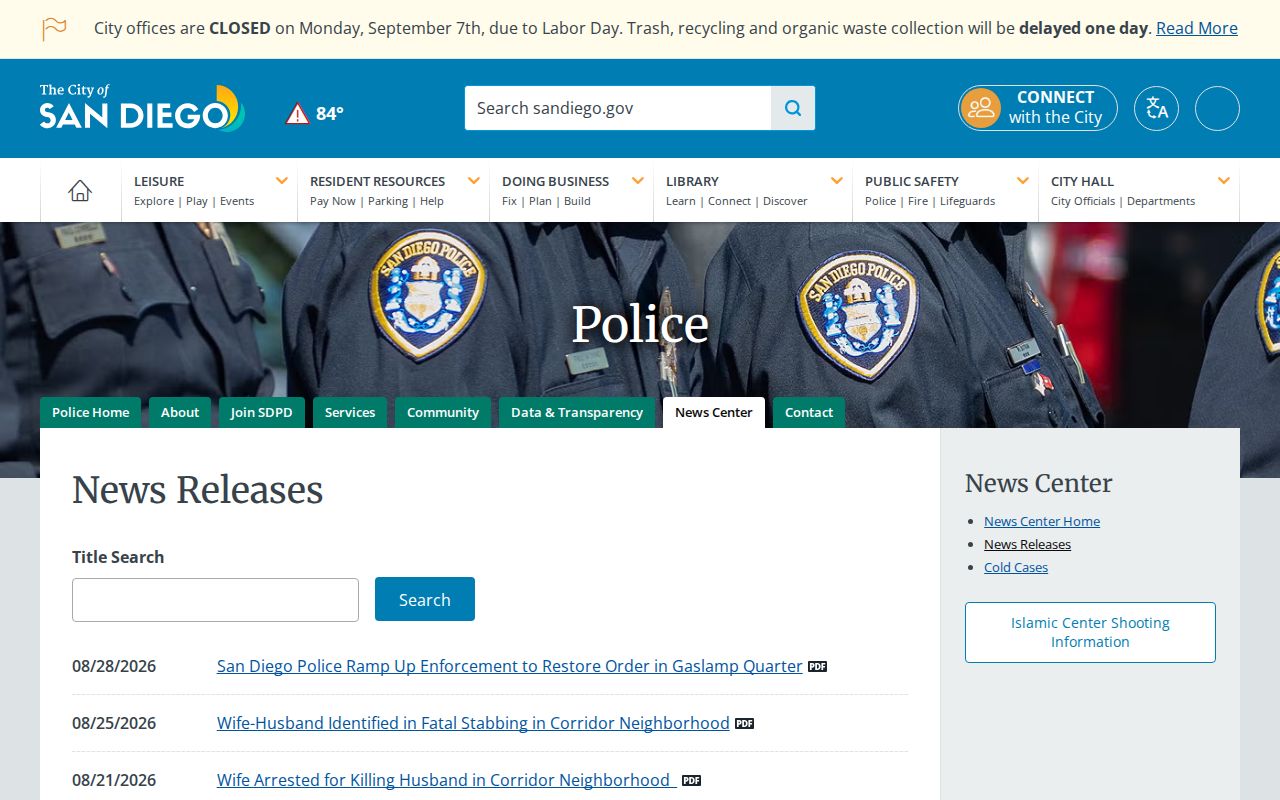
Read the dated release first. Then check the jail or court record. That source answers the custody question. News alone is not current arrest data.
San Diego Custody Status Changes
Bail status and a projected release date are temporary custody fields. They say nothing about the charged conduct. A hearing, a classification decision, a recalculation, or a transfer can change either figure. Save the date on any record you compare. A live Sheriff screen shifts after release. The SDPD incident report and the court file follow their own retention rules. Whenever you describe a San Diego arrest, name the agency and the record date. Current custody, a past booking, and the final disposition each answer a different question.